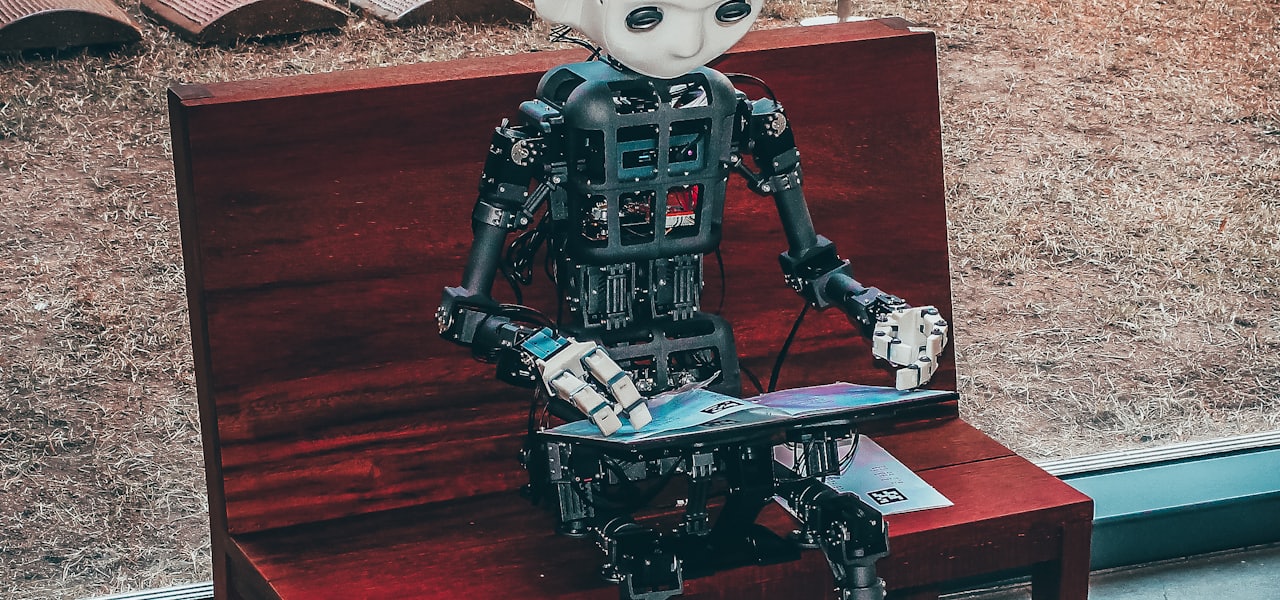
AI Chatbot For Student Queries

AI Chatbot For Student Queries — independent reviews, comparisons, pricing and step-by-step guides on Aizhi.

  • Document classification

    Document classification

    Document classification or document categorization is a problem in library science, information science and computer science. The task is to assign a document to one or more classes or categories. This may be done "manually" (or "intellectually") or algorithmically. The intellectual classification of documents has mostly been the province of library science, while the algorithmic classification of documents is mainly in information science and computer science. The problems are overlapping, however, and there is therefore interdisciplinary research on document classification. The documents to be classified may be texts, images, music, etc. Each kind of document possesses its special classification problems. When not otherwise specified, text classification is implied. Documents may be classified according to their subjects or according to other attributes (such as document type, author, printing year etc.). In the rest of this article only subject classification is considered. There are two main philosophies of subject classification of documents: the content-based approach and the request-based approach. == "Content-based" versus "request-based" classification == Content-based classification is classification in which the weight given to particular subjects in a document determines the class to which the document is assigned. It is, for example, a common rule for classification in libraries, that at least 20% of the content of a book should be about the class to which the book is assigned. In automatic classification it could be the number of times given words appears in a document. Request-oriented classification (or -indexing) is classification in which the anticipated request from users is influencing how documents are being classified. The classifier asks themself: “Under which descriptors should this entity be found?” and “think of all the possible queries and decide for which ones the entity at hand is relevant” (Soergel, 1985, p. 230). Request-oriented classification may be classification that is targeted towards a particular audience or user group. For example, a library or a database for feminist studies may classify/index documents differently when compared to a historical library. It is probably better, however, to understand request-oriented classification as policy-based classification: The classification is done according to some ideals and reflects the purpose of the library or database doing the classification. In this way it is not necessarily a kind of classification or indexing based on user studies. Only if empirical data about use or users are applied should request-oriented classification be regarded as a user-based approach. == Classification versus indexing == Sometimes a distinction is made between assigning documents to classes ("classification") versus assigning subjects to documents ("subject indexing") but as Frederick Wilfrid Lancaster has argued, this distinction is not fruitful. "These terminological distinctions,” he writes, “are quite meaningless and only serve to cause confusion” (Lancaster, 2003, p. 21). The view that this distinction is purely superficial is also supported by the fact that a classification system may be transformed into a thesaurus and vice versa (cf., Aitchison, 1986, 2004; Broughton, 2008; Riesthuis & Bliedung, 1991). Therefore, assigning a subject term to a document in an index is equivalent to assigning that document to the class of documents indexed by that term (all documents indexed or classified as X belong to the same class of documents). == Automatic document classification (ADC) == Automatic document classification tasks can be divided into three sorts: supervised document classification where some external mechanism (such as human feedback) provides information on the correct classification for documents, unsupervised document classification (also known as document clustering), where the classification must be done entirely without reference to external information, and semi-supervised document classification, where parts of the documents are labeled by the external mechanism. There are several software products under various license models available. === Techniques === Automatic document classification techniques include: Artificial neural network Concept Mining Decision trees such as ID3 or C4.5 Expectation maximization (EM) Instantaneously trained neural networks Latent semantic indexing Multiple-instance learning Naive Bayes classifier Natural language processing approaches Rough set-based classifier Soft set-based classifier Support vector machines (SVM) K-nearest neighbour algorithms tf–idf == Applications == Classification techniques have been applied to spam filtering, a process which tries to discern E-mail spam messages from legitimate emails email routing, sending an email sent to a general address to a specific address or mailbox depending on topic language identification, automatically determining the language of a text genre classification, automatically determining the genre of a text readability assessment, automatically determining the degree of readability of a text, either to find suitable materials for different age groups or reader types or as part of a larger text simplification system sentiment analysis, determining the attitude of a speaker or a writer with respect to some topic or the overall contextual polarity of a document. health-related classification using social media in public health surveillance article triage, selecting articles that are relevant for manual literature curation, for example as is being done as the first step to generate manually curated annotation databases in biology

    Read more →
  • Camera interface

    Camera interface

    The Camera Interface block or CAMIF is the hardware block that interfaces with different image sensor interfaces and provides a standard output that can be used for subsequent image processing. A typical Camera Interface would support at least a parallel interface although these days many camera interfaces are beginning to support the Mobile Industry Processor Interface (MIPI) Camera Serial Interface (CSI) interface. == Electrical connections == The camera interface's parallel interface consists of the following lines: 8 to 12 bits parallel data line These are parallel data lines that carry pixel data. The data transmitted on these lines change with every Pixel Clock (PCLK). Horizontal Sync (HSYNC) This is a special signal that goes from the camera sensor or ISP to the camera interface. An HSYNC indicates that one line of the frame is transmitted. Vertical Sync (VSYNC) This signal is transmitted after the entire frame is transferred. This signal is often a way to indicate that one entire frame is transmitted. Pixel Clock (PCLK) This is the pixel clock and it would change on every pixel. NOTE: The above lines are all treated as input lines to the Camera Interface hardware.

    Read more →
  • Tiki Wiki CMS Groupware

    Tiki Wiki CMS Groupware

    Tiki Wiki CMS Groupware or simply Tiki, originally known as TikiWiki, is a free and open source Wiki-based content management system and online office suite written primarily in PHP and distributed under the GNU Lesser General Public License (LGPL-2.1-only) license. In addition to enabling websites and portals on the internet and on intranets and extranets, Tiki contains a number of collaboration features allowing it to operate as a Geospatial Content Management System (GeoCMS) and Groupware web application. Tiki includes all the basic features common to most CMSs such as the ability to register and maintain individual user accounts within a flexible and rich permission / privilege system, create and manage menus, RSS-feeds, customize page layout, perform logging, and administer the system. All administration tasks are accomplished through a browser-based user interface. Tiki features an all-in-one design, as opposed to a core+extensions model followed by other CMSs. This allows for future-proof upgrades (since all features are released together), but has the drawback of an extremely large codebase (more than 1,000,000 lines). Tiki can run on any computing platform that supports both a web server capable of running PHP 5 (including Apache HTTP Server, IIS, Lighttpd, Hiawatha, Cherokee, and nginx) and a MySQL/MariaDB database to store content and settings. == Major components == Tiki has four major categories of components: content creation and management tools, content organization tools and navigation aids, communication tools, and configuration and administration tools. These components enable administrators and users to create and manage content, as well as letting them communicate to others and configure sites. In addition, Tiki allows each user to choose from various visual themes. These themes are implemented using CSS and the open source Smarty template engine. Additional themes can be created by a Tiki administrator for branding or customization as well. == Internationalization == Tiki is an international project, supporting many languages. The default interface language in Tiki is English, but any language that can be encoded and displayed using the UTF-8 encoding can be supported. Translated strings can be included via an external language file, or by translating interface strings directly, through the database. As of 29 September 2005, Tiki had been fully translated into eight languages and reportedly 90% or more translated into another five languages, as well as partial translations for nine additional languages. Tiki also supports interactive translation of actual wiki pages and was the initial wiki engine used in the Cross Lingual Wiki Engine Project. This allows Tiki-based web sites to have translated content — not just the user interface. == Implementation == Tiki is developed primarily in PHP with some JavaScript code. It uses MySQL/MariaDB as a database. It will run on any server that provides PHP 5, including Apache and Microsoft's IIS. Tiki components make extensive use of other open source projects, including Zend Framework, Smarty, jQuery, HTML Purifier, FCKeditor, Raphaël, phpCAS, and Morcego. When used with Mapserver Tiki can become a Geospatial Content Management System. == Project team == Tiki is under active development by a large international community of over 300 developers and translators, and is one of the largest open-source teams in the world. Project members have donated the resources and bandwidth required to host the tiki.org website and various subdomains. The project members refer to this dependence on their own product as "eating their own dogfood", which they have been doing since the early days of the project. Tiki community members also participate in various related events such as WikiSym and the Libre Software Meeting. == History == Tiki has been hosted on SourceForge.net since its initial release (Release 0.9, named Spica) in October 2002. It was primarily the development of Luis Argerich (Buenos Aires, Argentina), Eduardo Polidor (São Paulo, Brazil), and Garland Foster (Green Bay, WI, United States). In July 2003, Tiki was named the SourceForge.net July 2003 Project of the Month. In late 2003, a fork of Tiki was used to create Bitweaver. In 2006, Tiki was named to CMS Report's Top 30 Web Applications. In 2008, Tiki was named to EContent magazine's Top 100 In 2009, Tiki adopted a six-month release cycle and announced the selection of a Long Term Support (LTS) version and the Tiki Software Community Association was formed as the legal steward for Tiki. The Tiki Software Association is a not-for-profit entity established in Canada. Previously, the entire project was run entirely by volunteers. In 2010, Tiki received Best of Open Source Software Applications Award (BOSSIE) from InfoWorld, in the Applications category. In 2011, Tiki was named to CMS Report's Top 30 Web Applications. In 2012, Tiki was named "Best Web Tool" by WebHostingSearch.com, and "People's Choice: Best Free CMS" by CMS Critic. In 2016, Tiki was named as one of the "10 Best Open Source Collaboration Software Tools" by Small Business Computing. == Name == The name TikiWiki is written in CamelCase, a common Wiki syntax indicating a hyperlink within the Wiki. It is most likely a compound word combining two Polynesian terms, Tiki and Wiki, to create a self-rhyming name similar to wikiwiki, a common variant of wiki. A backronym has also been formed for Tiki: Tightly Integrated Knowledge Infrastructure. == Release Information and History == In general, the Tiki Software Community Association releases a new major version of Tiki Wiki every 8 months where prior, non-LTS, major versions are supported until the first minor version release of the next major version (i.e., 16.0 ⇒ 17.1). Starting with version 12.x, Tiki Wiki LTS is supported for 5 years where it enters a security/maintenance release cycle upon the release of the next LTS version. Tiki Wiki's release history is outlined below.

    Read more →
  • Object model

    Object model

    In computing, object model has two related but distinct meanings: The properties of objects in general in a specific computer programming language, technology, notation or methodology that uses them. Examples are the object models of Java, the Component Object Model (COM), or Object-Modeling Technique (OMT). Such object models are usually defined using concepts such as class, generic function, message, inheritance, polymorphism, and encapsulation. There is an extensive literature on formalized object models as a subset of the formal semantics of programming languages. A collection of objects or classes through which a program can examine and manipulate some specific parts of its world. In other words, the object-oriented interface to some service or system. Such an interface is said to be the object model of the represented service or system. For example, the Document Object Model (DOM) is a collection of objects that represent a page in a web browser, used by script programs to examine and dynamically change the page. There is a Microsoft Excel object model [1] for controlling Microsoft Excel from another program, and the ASCOM Telescope Driver is an object model for controlling an astronomical telescope. == Features == An object model consists of the following important features: === Object reference === Objects can be accessed via object references. To invoke a method in an object, the object reference and method name are given, together with any arguments. === Interfaces === An interface provides a definition of the signature of a set of methods without specifying their implementation. An object will provide a particular interface if its class contains code that implement the method of that interface. An interface also defines types that can be used to declare the type of variables or parameters and return values of methods. === Actions === An action in object-oriented programming (OOP) is initiated by an object invoking a method in another object. An invocation can include additional information needed to carry out the method. The receiver executes the appropriate method and then returns control to the invoking object, sometimes supplying a result. === Exceptions === Programs can encounter various errors and unexpected conditions of varying seriousness. During the execution of the method many different problems may be discovered. Exceptions provide a clean way to deal with error conditions without complicating the code. A block of code may be defined to throw an exception whenever particular unexpected conditions or errors arise. This means that control passes to another block of code that catches the exception.

    Read more →
  • Anti-Grain Geometry

    Anti-Grain Geometry

    Anti-Grain Geometry (AGG) is a 2D rendering graphics library written in C++. It features anti-aliasing and sub-pixel resolution. It is not a graphics library, per se, but rather a framework to build a graphics library upon. The library is operating system independent and renders to an abstract memory object. It comes with examples interfaced to the X Window System, Microsoft Windows, Mac OS X, AmigaOS, BeOS, SDL. The examples also include an SVG viewer. The design of AGG uses C++ templates only at a very high level, rather than extensively, to achieve the flexibility to plug custom classes into the rendering pipeline, without requiring a rigid class hierarchy, and allows the compiler to inline many of the method calls for high performance. For a library of its complexity, it is remarkably lightweight: it has no dependencies above the standard C++ libraries and it avoids the C++ STL in the implementation of the basic algorithms. The implicit interfaces are not well documented, however, and this can make the learning process quite cumbersome. While AGG version 2.5 is licensed under the GNU General Public License, version 2 or greater, AGG version 2.4 is still available under the 3-clause BSD license and is virtually the same as version 2.5. == History == Active development of the AGG codebase stalled in 2006, around the time of the v2.5 release, due to shifting priorities of its main developer and maintainer Maxim Shemanarev. M. Shemanarev remained active in the community until his sudden death in 2013. Development has continued on a fork of the more liberally licensed v2.4 on SourceForge.net. == Usage == The Haiku operating system uses AGG in its windowing system. It is one of the renderers available for use in GNU's Gnash Flash player. Graphical version of Rebol language interpreter is using AGG for scalable vector graphics DRAW dialect. Hilti uses it in some of their rebar detection tools, like the PS 1000. Matplotlib uses AGG as its canonical renderer for interactive user interfaces. fpGUI Toolkit has an optional AggPas back-end rendering engine. Work is being done to make AggPas the default or sole rendering engine for fpGUI. Mapnik, the toolkit that renders the maps on the OpenStreetMap website, uses AGG for all its bitmap map rendering by default. HTTPhotos uses AGG to scale photos. Pdfium, the PDF rendering engine used by Google Chrome makes use of AGG, although work is progressing to replace this with Skia Graphics Engine. Graphics Mill, the .NET imaging SDK uses AGG as its drawing engine. Image-Line FL Studio, a digital audio workstation, since version 10.8 released on September 30, 2012, uses AGG for drawing. Native Instruments's Supercharger and Supercharger GT compressors use AGG for its user interface. == Author == The main author of the library was Maxim Shemanarev (Russian: Максим Шеманарёв). On November 26, 2013 Shemanarev (born June 15, 1966, Nizhny Novgorod, Russia) was reported dead at the age of 47 at his home in Columbia, Maryland (US). He died suddenly, allegedly from an epileptic seizure that he had suffered for a while. He was a graduate from Nizhny Novgorod State Technical University. Little is known about his personal life. It's known though that he was divorced and his mother was alive at the time of his death. He used to love skiing, snowboarding (in Colorado), and inline skating. He was praised by his friends for his intelligent programming skills.

    Read more →
  • Kubity

    Kubity

    Kubity is a cloud-based 3D communication tool that works on desktop computers, the web, smartphones, tablets, augmented reality gear, and virtual reality glasses. Kubity is powered by several proprietary 3D processing engines including "Paragone" and "Etna" that prepare the 3D file for transfer over mobile devices. Kubity has practical applications for architecture, interior design, engineering, product design, film, and video games among others. The majority of its users create 3D models using SketchUp or Autodesk Revit software. Kubity products include the Kubity web app and Kubity Go (a mobile application for iOS and Android). Kubity is compatible across many platforms, devices and operating systems including: iOS, Android, Firefox, Chrome, Windows, MacOS, and Linux. == History == Kubity was created by SPK Technology (ex Kubity S.A.S.), a Paris-based software company specializing in automatic 3D data optimization and visualization. Founded in 2012 by a group of software engineers and an urban projects developer, they united around a simple idea: create a way for anyone, anywhere to simply and intuitively explore 3D models on smartphones and computers. In order to bring architects, engineers and designers together with their clients around a 3D model, it was essential to develop an interactive platform that supported multiple desktop and mobile devices for instantaneous and fluid 3D navigation. With specifications in place, 15 engineers fused together several technologies: 3D design, data compression, decimation and rendering optimization, web and mobile transfer, and virtual reality headset integration. In January 2014, the first public Kubity prototype (1.0 Amethyst) was launched to a small group of beta testers with a plug-in that allowed users to import 3D models from SketchUp to their browser. A global release was announced in April 2014 at the SketchUp Basecamp in Vail, Colorado. In May 2015, Kubity launched a web application that worked using WebGL technology (2.0 Citrine). For the first time, users were able to drag and drop any SketchUp file in a web browser without having to install a plug-in. In December 2015, Kubity launched a mobile application on the App Store for iPhone, iPod, and iPad as well as on Google Play for Android devices (3.0 Druzy). In November 2016, Kubity launched support for Oculus Rift and HTC Vive (4.0 Emerald). Beginning in November 2017, Kubity launched a full suite rollout of mobile applications over six months that included Kubity AR for augmented reality, Kubity VR for virtual reality, and Kubity Mirror for remote presentations and screen mirroring (5.0 Feldspar). In September 2018, a one-click plugin for SketchUp and Revit (Kubity PRO), along with a mobile-first revamp of Kubity Go was launched, allowing PRO-to-Go device pairing for automatic mobile sync (6.0 Gypsum). In early 2019, the Kubity Go application was updated to include fully integrated AR, VR, and screen mirroring functionalities, killing off the dedicated companion apps Kubity AR, Kubity VR and Kubity Mirror in the process (7.0 Heliotrope). In January 2020, support for the Kubity PRO plugin for SketchUp and Revit was migrated to a SketchUp-only web app. == Technology == Kubity is powered by a proprietary 3D crystallization engine known as "Paragone"; a technology developed by SPK Technology. Paragone takes constrained information from a 3D file and runs it through the "BlockWave" algorithm (US Patent 10,482.629), also developed by SPK Technology. BlockWave is a multiphase optimization algorithm that combines 3D design, data compression, decimation and rendering optimization, web and mobile transfer, and mixed reality headset integration to create a crystallized universal format of the original file. One phase of the BlockWave algorithm is based on the quadric-based polygonal surface simplification algorithm, performed using predefined heuristics, and is associated with a plurality of simplified versions of the 3D model, each version being associated with a predefined level of detail adapted to the user specific end device. BlockWave extracts data content, geometry and textures, then sets quadrics for each top of the original 3D model, and identifies pairs of adjacent tops linked by vertices. The algorithm uses a local collapsing operator and a top-plan error metric to obtain a fixed number of faces or a maximum defined error; 3D meshing is simplified by replacing two points with one, then deleting the degrading faces and updating adjacent relations. Once decimation is completed, texture optimization is set using texture target parameters allowing maximized GPU memory to improve computing time. With texture encoding completed, the crystallized universal 3D file can now be easily opened on any user-specific end device and played across most digital devices with real-time rendering. == Features == === 3D Crystallization === A user converts (or crystallizes) a 3D file by exporting it with the Kubity web app. Crystallization adds features like AR/VR and cinematic fly-through tour as well as assigns the model a dedicated QR code. === Automatic Mobile Sync === When a 3D model is exported, it is automatically synced to Kubity Go on the user's mobile device. From there, it can be accessed, explored, and shared with others with or without an internet connection. === Security and Management === User models can be managed all in one place on Kubity Go or in a browser from their account. Models can be renamed, password-protected, shared, and played. === Augmented Reality === Developed using Apple ARKit and Google ARCore technology, Kubity Go's augmented reality feature maps the environment in a room detecting horizontal planes like tables and floors to track and place 3D objects. By blending digital objects and information with the environment, Kubity allows users to interact with 3D models in true augmented reality. Built-in communication features allows users to instantly share 3D models with anyone over text, email, social media, or direct device-to-device with a QR Code. Platform Support AR supports devices running iOS11 including: iPhone SE, iPhone 6s, iPhone 6s Plus, iPhone 7, iPhone 7 Plus, iPhone 8, iPhone X, all iPad Pro models, and iPad (2017). AR for Android requires Android 7.0 or later and access to the Google Play Store. === Virtual Reality === VR allows users to explore SketchUp models and Revit projects on-the-go right from a mobile device using Oculus Go, Google Cardboard, Samsung Gear VR, or the glasses-free Magic Window feature. Kubity's virtual reality feature is compatible with Oculus Go, Google Cardboard viewers and other cardboard compatible devices including clip-on style VR glasses like Homido Mini, as well as the mobile virtual reality headset, Samsung Gear VR. Samsung Gear VR supports: Galaxy S6, Galaxy S6 Edge, Galaxy S6 Edge+, Samsung Galaxy Note 5, Galaxy S7, Galaxy S7 Edge, Galaxy S8, Galaxy S8+, Samsung Galaxy Note Fan Edition, Samsung Galaxy Note 8, Samsung Galaxy A8/A8+ (2018), and Samsung Galaxy S9/Galaxy S9+. === Screen Mirroring === Screen mirroring allows a user to sync the sender device to a receiver on a webpage, then control from the sender device to give a remote presentation of the 3D model. Devices are easily synced by entering a six-digit number displayed on the receiving computer. == Platform support == On iOS, the Kubity application is compatible with devices running on the version 9.0 or higher. On Android, Kubity is compatible with devices running on the version 4.4 “Kit Kat” or higher. The web version of Kubity applications currently support web browsers compatible with WebGL2 : Mozilla Firefox and Google Chrome. AR is compatible with devices running iOS11 including: iPhone SE, iPhone 6s, iPhone 6s Plus, iPhone 7, iPhone 7 Plus, iPhone 8, iPhone X, all iPad Pro models, and iPad (2017), and Android devices. Requires Android 7.0 or later and access to the Google Play Store. VR is compatible with Google Cardboard viewers and other cardboard compatible devices including clip-on style VR glasses like Homido Mini, as well as the Samsung Gear VR and Oculus Go. Samsung Gear VR supports: Galaxy S6, Galaxy S6 Edge, Galaxy S6 Edge+, Samsung Galaxy Note 5, Galaxy S7, Galaxy S7 Edge, Galaxy S8, Galaxy S8+, Samsung Galaxy Note Fan Edition, Samsung Galaxy Note 8, Samsung Galaxy A8/A8+ (2018) and Samsung Galaxy S9/Galaxy S9+.

    Read more →
  • List & Label

    List & Label

    List & Label is a professional reporting tool for software developers. It provides comprehensive design, print and export functions. The software component runs on Microsoft Windows and can be implemented in desktop, cloud and web applications. List & Label can be used to create user-defined dashboards, lists, invoices, forms and labels. It supports many development environments, frameworks and programming languages such as Microsoft Visual Studio, Embarcadero RAD Studio, .NET Framework, .NET Core, ASP.NET, C++, Delphi, Java, C Sharp and some more. List & Label either retrieves data from various sources via data binding, or works database independent. Reports are designed and created in the so-called List & Label Designer and then exported into a multitude of formats like PDF, Excel, XHTML and RTF. Since version 27 a web report designer for ASP.NET MVC is available. == History == The product was first released in 1992 by combit. The current version is 30. A new major version of List & Label is released every fall, usually in October. Updates are available several times a year via Service Pack. == Features == === Report Designer === The Designer enables users to graphically layout the report. It offers report objects such as tables, charts, crosstabs, gauges, HTML, conditionally formatted text, barcodes, matrix codes, and graphics, and is extensible using third-party add-ons. User applications can interact with the report via the programmable object model of the report. The real-time preview functionality allows users to view changes instantly. Usability features include layer and appearance management, enabling conditional logic to dynamically control the visibility of objects in reports. The Designer also supports the inclusion of multiple report containers in a single project, accommodating complex layouts such as parallel tables and charts. A formula wizard and support for scripting languages such as C# facilitate advanced calculations and logic. The Designer's object model (DOM) provides developers with the ability to modify layouts and behaviors programmatically. === Web Report Designer === The web report designer works browser-based and independent from printer drivers and spoolers - that makes deployments to the cloud easier. Just like the use of the Visual Studio deployment pipeline. === Data Sources === Depending on the programming language, the product offers automatic support for data sources: Databases such as Microsoft SQL Server, Oracle, MySQL, PostgreSQL, IBM Db2, SQLite, MariaDB, MongoDB, Cosmos DB XML data, CSV Business objects Data sources that can be accessed via OLE DB, ODBC or ADO.NET LINQ data and data from web services GraphQL Additionally, the product offers support for unbound data and can be extended to support other data sources via interfaces. === Output Options === Printer Image Formats (JPEG, BMP, EMF, TIFF, PNG, SVG, HEIF, WebP) Document Formats: PDF, PDF/A, Word (DOCX), Excel (XLS), PowerPoint (PPTX) HTML, XHTML, MHTML Barcodes Plain Text, RTF, CSV, JSON XML, ZIP, Email, JSON List & Label preview file === Target Audience === List & Label can be used in Windows development environments. While it competes most notably on the Microsoft .NET platform with other products such as Crystal Reports, SQL Server Reporting Services, ActiveReports, there are few competing products for other programming languages (e.g. Progress, Alaska Xbase++, Visual DataFlex). == Awards == Reader's Choice Award 2005–2008 Stevie Awards 2021: Best Technology for Data Visualization Top 100 Publisher Award Component Source 2013-2014, 2014-2015,2016, 2018, 2019, 2020, 2021, 2022

    Read more →
  • LiveChat

    LiveChat

    LiveChat is an AI customer service software with chatbot, online chat, help desk software, and web analytics capabilities. LiveChat is used by over 76,000 companies. It was first launched in 2002 and is offered via a SaaS (software as a service) business model by Text. Organizations use LiveChat as a single point of contact to manage customer service and online sales activities with a single program. == Product == LiveChat is proprietary software. LiveChat's website chat widget can be embedded on customers' websites as a small chat box, often displayed in the bottom right corner of the web browser. It can be used to conduct chats, share files and save transcripts. The agent application is used by company employees to respond to questions asked by the customers. This is available through both web-based application, desktop applications, and mobile apps. Web chat sessions can be initiated by the visiting customer, or by the agent, either manually or automatically by the LiveChat system when the visitor meets the predefined criteria (i.e. searched keyword, time on website, encountered error, etc.). LiveChat's system attempts to identify the best prospects visiting a website based on data gathered from past purchasing decisions. Other features include real-time website traffic monitoring, built-in ticketing system and agents' efficiency analytics. LiveChat is available in 48 languages. == Research and reception == Reviewing LiveChat's usefulness for online learning in 2020, psychologist Jaclyn Broadbent said "LiveChat occurs as a real-time conversation, it can be time-consuming for staff and disruptive to other tasks." However, using it has resulted in reduced communication traffic from other channels, such as the discussion boards or email. As a teacher, the best time to be available on LiveChat is when you are doing other administrative jobs." Since 2014 LiveChat has been publishing Customer Service Report - an annual study of customer satisfaction and analysis of online business communication trends. It includes research of thousands of companies and millions of customer service email and live support interactions.

    Read more →
  • XLeratorDB

    XLeratorDB

    XLeratorDB is a suite of database function libraries that enable Microsoft SQL Server to perform a wide range of additional (non-native) business intelligence and ad hoc analytics. The libraries, which are embedded and run centrally on the database, include more than 450 individual functions similar to those found in Microsoft Excel spreadsheets. The individual functions are grouped and sold as six separate libraries based on usage: finance, statistics, math, engineering, unit conversions and strings. WestClinTech, the company that developed XLeratorDB, claims it is "the first commercial function package add-in for Microsoft SQL Server." == Company history == WestClinTech (LLC), founded by software industry veterans Charles Flock and Joe Stampf in 2008, is located in Irvington, New York, United States. Flock was a co-founder of The Frustum Group, developer of the OPICS enterprise banking and trading platform, which was acquired by London-based Misys, PLC in 1996. Stampf joined Frustum in 1994 and with Flock remained active with the company after acquisition, helping to develop successive generations of OPICS now employed by over 150 leading financial institutions worldwide. Following a full year of research, development and testing, WestClinTech introduced and recorded its first commercial sale of XLeratorDB in April 2009. In September 2009, XLeratorDB became available to all Federal agencies through NASA's Strategic Enterprise-Wide Procurement (SEWP-IV) program, a government-wide acquisition contract. == Technology == XLeratorDB uses Microsoft SQL CLR(Common Language Runtime) technology. SQL CLR allows managed code to be hosted by, and run in, the Microsoft SQL Server environment. SQL CLR relies on the creation, deployment and registration of .NET Framework assemblies that are physically stored in managed code dynamic-link libraries (DLL). The assemblies may contain .NET namespaces, classes, functions, and properties. Because managed code compiles to native code prior to execution, functions using SQL CLR can achieve significant performance increases versus the equivalent functions written in T-SQL in some scenarios. XLeratorDB requires Microsoft SQL Server 2005 or SQL Server 2005 Express editions, or later (compatibility mode 90 or higher). The product installs with PERMISSION_SET=SAFE. SAFE mode, the most restrictive permission set, is accessible by all users. Code executed by an assembly with SAFE permissions cannot access external system resources such as files, the network, the internet, environment variables, or the registry. == Functions == In computer science, a function is a portion of code within a larger program which performs a specific task and is relatively independent of the remaining code. As used in database and spreadsheet applications these functions generally represent mathematical formulas widely used across a variety of fields. While this code may be user-generated, it is also embedded as a pre-written sub-routine in applications. These functions are typically identified by common nomenclature which corresponds to their underlying operations: e.g. IRR identifies the function which calculates Internal Rate of Return on a series of periodic cash flows. === Function uses === As subroutines, functions can be integrated and used in a variety of ways, and as part of larger, more complicated applications. Within large enterprise applications they may, for example, play an important role in defining business rules or risk management parameters, while remaining virtually invisible to end users. Within database management systems and spreadsheets, however, these kinds of functions also represent discrete sets of tools; they can be accessed directly and utilized on a stand-alone basis, or in more complex, user-defined configurations. In this context, functions can be used for business intelligence and ad hoc analysis of data in fields such as finance, statistics, engineering, math, etc. === Function types === XLeratorDB uses three kinds of functions to perform analytic operations: scalar, aggregate, and a hybrid form which WestClinTech calls Range Queries. Scalar functions take a single value, perform an operation and return a single value. An example of this type of function is LOG, which returns the logarithm of a number to a specified base. Aggregate functions operate on a series of values but return a single, summarizing value. An example of this type of function is AVG, which returns the average of values in a specified group. In XLeratorDB there are some functions which have characteristics of aggregate functions (operating on multiple series of values) but cannot be processed in SQL CLR using single column inputs, such as AVG does. For example, irregular internal rate of return (XIRR), a financial function, operates on a collection of cash flow values from one column, but must also apply variable period lengths from another column and an initial iterative assumption from a third, in order to return a single, summarizing value. WestClinTech documentation notes that Range Queries specify the data to be included in the result set of the function independently of the WHERE clause associated with the T-SQL statement, by incorporating a SELECT statement into the function as a string argument; the function then traps that SELECT statement, executes it internally and processes the result. Some XLeratorDB functions that employ Range Queries are: NPV, XNPV, IRR, XIRR, MIRR, MULTINOMIAL, and SERIESSUM. Within the application these functions are identified by a "_q" naming convention: e.g. NPV_q, IRR_q, etc. == Analytic functions == === SQL Server functions === Microsoft SQL Server is the #3 selling database management system (DBMS), behind Oracle and IBM. (While versions of SQL Server have been on the market since 1987, XLeratorDB is compatible with only the 2005 edition and later.) Like all major DBMS, SQL Server performs a variety of data mining operations by returning or arraying data in different views (also known as drill-down). In addition, SQL Server uses Transact-SQL (T-SQL) to execute four major classes of pre-defined functions in native mode. Functions operating on the DBMS offer several advantages over client layer applications like Excel: they utilize the most up-to-date data available; they can process far larger quantities of data; and, the data is not subject to exporting and transcription errors. SQL Server 2008 includes a total of 58 functions that perform relatively basic aggregation (12), math (23) and string manipulation (23) operations useful for analytics; it includes no native functions that perform more complex operations directly related to finance, statistics or engineering. === Excel functions === Microsoft Excel, a component of Microsoft Office suite, is one of the most widely used spreadsheet applications on the market today. In addition to its inherent utility as a stand-alone desktop application, Excel overlaps and complements the functionality of DBMS in several ways: storing and arraying data in rows and columns; performing certain basic tasks such as pivot table and aggregating values; and facilitating sharing, importing and exporting of database data. Excel's chief limitation relative to a true database is capacity; Excel 2003 is limited to some 65k rows and 256 columns; Excel 2007 extends this capacity to roughly 1million rows and 16k columns. By comparison, SQL Server is able to manage over 500k terabytes of memory. Excel offers, however, an extensive library of specialized pre-written functions which are useful for performing ad hoc analysis on database data. Excel 2007 includes over 300 of these pre-defined functions, although customized functions can also be created by users, or imported from third party developers as add-ons. Excel functions are grouped by type: === Excel business intelligence functions === Operating on the client computing layer Excel plays an important role as a business intelligence tool because it: performs a wide array of complex analytic functions not native to most DBMS software offers far greater ad hoc reporting and analytic flexibility than most enterprise software provides a medium for sharing and collaborating because of its ubiquity throughout the enterprise Microsoft reinforces this positioning with Business Intelligence documentation that positions Excel in a clearly pivotal role. === XLeratorDB vs. Excel functions === While operating within the database environment, XLeratorDB functions utilize the same naming conventions and input formats, and in most cases, return the same calculation results as Excel functions. XLeratorDB, coupled with SQL Server's native capabilities, compares to Excel's function sets as follows:

    Read more →
  • Cloud-based quantum computing

    Cloud-based quantum computing

    Cloud-based quantum computing refers to the remote access of quantum computing resources—such as quantum emulators, simulators, or processors—via the internet. Cloud access enables users to develop, test, and execute quantum algorithms without the need for direct interaction with specialized hardware, facilitating broader participation in quantum software development and experimentation. In 2016, IBM launched the IBM Quantum Experience, one of the first publicly accessible quantum processors connected to the cloud. In early 2017, researchers at Rigetti Computing demonstrated programmable quantum cloud access through their software platform Forest, which included the pyQuil Python library. Since the early-2020s, cloud-based quantum computing has grown significantly, with multiple providers offering access to a variety of quantum hardware modalities, including superconducting qubits, trapped ions, neutral atoms, and photonic systems. Major platforms such as Amazon Braket, Azure Quantum, and qBraid aggregate quantum devices from hardware developers like IonQ, Rigetti Computing, QuEra, Pasqal, Oxford Quantum Circuits, and IBM Quantum. These platforms provide unified interfaces for users to write and execute quantum algorithms across diverse backends, often supporting open-source SDKs such as Qiskit, Cirq, and PennyLane. The proliferation of cloud-based access has played a key role in accelerating quantum education, algorithm research, and early-stage application development by lowering the barrier to experimentation with real quantum hardware. Cloud-based quantum computing has expanded access to quantum hardware and tools beyond traditional research laboratories. These platforms support educational initiatives, algorithm development, and early-stage commercial applications. == Applications == Cloud-based quantum computing is used across education, research, and software development, offering remote access to quantum systems without the need for on-site infrastructure. === Education === Quantum cloud platforms have become valuable tools in education, allowing students and instructors to engage with real quantum processors through user-friendly interfaces. Educators use these platforms to teach foundational concepts in quantum mechanics and quantum computing, as well as to demonstrate and implement quantum algorithms in a classroom or laboratory setting. === Scientific Research === Cloud-based access to quantum hardware has enabled researchers to conduct experiments in quantum information, test quantum algorithms, and compare quantum hardware platforms. Experiments such as testing Bell's theorem or evaluating quantum teleportation protocols have been performed on publicly available quantum processors. === Software Development and Prototyping === Developers use cloud-based platforms to prototype quantum software applications across fields such as optimization, machine learning, and chemistry. These platforms offer SDKs and APIs that integrate classical and quantum workflows, enabling experimentation with quantum algorithms in real-world or simulated environments. === Public Engagement and Games === Quantum cloud tools have also been used to create educational games and interactive applications aimed at increasing public understanding of quantum concepts. These efforts help bridge the gap between theoretical content and intuitive learning. == Existing platforms == qBraid Lab by qBraid is a cloud-based platform for quantum computing. It provides software tools for researchers and developers in quantum, as well as access to quantum hardware. qBraid provides cloud based access to Microsoft Azure Quantum and Amazon Braket devices including IQM, QuEra, Pasqal, Rigetti, IonQ, QIR simulators, Amazon Braket simulators, and the NEC Vector Annealer, as of August 2025. qBraid's base version is free, where unlimited hardware and simulator access is available with the purchase of credits. Quandela Cloud by Quandela is the platform to access first cloud-accessible European photonic quantum computer. The computer is interfaced using the Perceval scripting language, with tutorials and documentation available online for free. Xanadu Quantum Cloud by Xanadu is a platform with cloud-based access to three fully programmable photonic quantum computers. Forest by Rigetti Computing is a tool suite for cloud-based quantum computing. It includes a programming language, development tools and example algorithms. LIQUi> by Microsoft is a software architecture and tool suite for quantum computing. It includes a programming language, example optimization and scheduling algorithms, and quantum simulators. Q#, a quantum programming language by Microsoft on the .NET Framework seen as a successor to LIQUi|>. IBM Quantum Platform by IBM, providing access to quantum hardware as well as HPC simulators. These can be accessed programmatically using the Python-based Qiskit framework, or via graphical interface with the IBM Q Experience GUI. Both are based on the OpenQASM standard for representing quantum operations. There is also a tutorial and online community. Quantum in the Cloud by The University of Bristol, which consists of a quantum simulator and a four qubit optical quantum system. Quantum Playground by Google is an educational resource which features a simulator with a simple interface, and a scripting language and 3D quantum state visualization. Quantum in the Cloud is an experimental quantum cloud platform for access to a four-qubit nuclear magnetic resonance-NMRCloudQ computer, managed by Tsinghua University. Quantum Inspire by Qutech is the first platform in Europe providing cloud-based quantum computing to two hardware chips. Next to a 5-qubit transmon processor, Quantum Inspire is the first platform in the world to provide online access to a fully programmable 2-qubit electron spin quantum processor. Amazon Braket is a cloud-based quantum computing platform hosted by AWS which, as of June 2025, provides access to quantum computers built by IonQ, Rigetti, IQM, and QuEra. Braket also provides a quantum algorithm development environment and simulator. Forge by QC Ware is a cloud-based quantum computing platform that provides access to D-Wave hardware, as well as Google and IBM simulators. The platform offers a 30-day free trial, including one minute of quantum computing time. Quantum-as-a-Service by Scaleway is a cloud-based platform created in 2022 to access to real quantum hardware from IQM Quantum Computers, Alpine Quantum Technologies, Quandela and Pasqal. It also include access to GPU-powered emulators such as Aer, Qsim and Quandela proprietary emulation.

    Read more →
  • Actifsource

    Actifsource

    Actifsource is a domain-specific modeling workbench. It is realized as plug-in for the software development environment Eclipse. Actifsource supports the creation of multiple domain models which can be linked together. It comes with a UML-like graphical editor to create domain-specific languages and a general graphical editor to edit structures in the created languages. It supports code generation using user-defined generic code templates which are directly linked to the domain models. Code generation is integrated into Eclipse's incremental build process. == Interoperability == Actifsource can use models from other modelling tools by importing and exporting the ecore format which is defined by the Eclipse Modeling Framework. == Licensing policy == There are two versions of actifsource available: The free community edition which can be used freely for non-commercial projects and the enterprise edition which contains additional features. The enterprise edition comes with customer support and maintenance for a limited period of time. This package allows the customers to upgrade to new versions and maintenance releases during their support period.

    Read more →
  • Client-side persistent data

    Client-side persistent data

    Client-side persistent data or CSPD is a term used in computing for storing data required by web applications to complete internet tasks on the client-side as needed rather than exclusively on the server. As a framework it is one solution to the needs of Occasionally connected computing or OCC. A major challenge for HTTP as a stateless protocol has been asynchronous tasks. The AJAX pattern using XMLHttpRequest was first introduced by Microsoft in the context of the Outlook e-mail product. The first CSPD were the 'cookies' introduced by the Netscape Navigator. ActiveX components which have entries in the Windows registry can also be viewed as a form of client-side persistence.

    Read more →
  • Automaton

    Automaton

    An automaton ( ; pl.: automata or automatons) is a relatively self-operating machine or control mechanism designed to automatically follow a sequence of operations or respond to predetermined instructions. Some automata, such as bellstrikers in mechanical clocks, are designed to give the illusion to the casual observer that they are operating under their own power or will, like a mechanical robot. The term has long been commonly associated with automated puppets that resemble moving humans or animals, built to impress and/or to entertain people. Animatronics are a modern type of automata with electronics, often used for the portrayal of characters or creatures in films and in theme park attractions. == Etymology == The word automaton is the latinization of the Ancient Greek automaton (αὐτόματον), which means "acting of one's own will". It was first used by Homer to describe an automatic door opening, or automatic movement of wheeled tripods. It is more often used to describe non-electronic moving machines, especially those that have been made to resemble human or animal actions, such as the jacks on old public striking clocks, or the cuckoo and any other animated figures on a cuckoo clock. == History == === Ancient === There are many examples of automata in Greek mythology: Hephaestus created automata for his workshop; Talos was an artificial man of bronze; King Alkinous of the Phaiakians employed gold and silver watchdogs. According to Aristotle, Daedalus used quicksilver to make his wooden statue of Aphrodite move. In other Greek legends he used quicksilver to install voice in his moving statues. The automata in the Hellenistic world were intended as tools, toys, religious spectacles, or prototypes for demonstrating basic scientific principles. Numerous water-powered automata were built by Ktesibios, a Greek inventor and the first head of the Great Library of Alexandria; for example, he "used water to sound a whistle and make a model owl move. He had invented the world's first 'cuckoo clock'". This tradition continued in Alexandria with inventors such as the Greek mathematician Hero of Alexandria (sometimes known as Heron), whose writings on hydraulics, pneumatics, and mechanics described siphons, a fire engine, a water organ, the aeolipile, and a programmable cart. Philo of Byzantium was famous for his inventions. Complex mechanical devices are known to have existed in Hellenistic Greece, though the only surviving example is the Antikythera mechanism, the earliest known analog computer. The clockwork is thought to have come originally from Rhodes, where there was apparently a tradition of mechanical engineering; the island was renowned for its automata; to quote Pindar's seventh Olympic Ode: The animated figures stand Adorning every public street And seem to breathe in stone, or move their marble feet. However, the information gleaned from recent scans of the fragments indicate that it may have come from the colonies of Corinth in Sicily and implies a connection with Archimedes. According to Jewish legend, King Solomon used his wisdom to design a throne with mechanical animals which hailed him as king when he ascended it; upon sitting down an eagle would place a crown upon his head, and a dove would bring him a Torah scroll. It is also said that when King Solomon stepped upon the throne, a mechanism was set in motion. As soon as he stepped upon the first step, a golden ox and a golden lion each stretched out one foot to support him and help him rise to the next step. On each side, the animals helped the King up until he was comfortably seated upon the throne. In ancient China, a curious account of automata is found in the Lie Zi text, believed to have originated around 400 BCE and compiled around the fourth century CE. Within it there is a description of a much earlier encounter between King Mu of Zhou (1023–957 BCE) and a mechanical engineer known as Yan Shi, an 'artificer'. The latter proudly presented the king with a very realistic and detailed life-size, human-shaped figure of his mechanical handiwork: The king stared at the figure in astonishment. It walked with rapid strides, moving its head up and down, so that anyone would have taken it for a live human being. The artificer touched its chin, and it began singing, perfectly in tune. He touched its hand, and it began posturing, keeping perfect time...As the performance was drawing to an end, the robot winked its eye and made advances to the ladies in attendance, whereupon the king became incensed and would have had Yen Shih [Yan Shi] executed on the spot had not the latter, in mortal fear, instantly taken the robot to pieces to let him see what it really was. And, indeed, it turned out to be only a construction of leather, wood, glue and lacquer, variously coloured white, black, red and blue. Examining it closely, the king found all the internal organs complete—liver, gall, heart, lungs, spleen, kidneys, stomach and intestines; and over these again, muscles, bones and limbs with their joints, skin, teeth and hair, all of them artificial...The king tried the effect of taking away the heart, and found that the mouth could no longer speak; he took away the liver and the eyes could no longer see; he took away the kidneys and the legs lost their power of locomotion. The king was delighted. Other notable examples of automata include Archytas' dove, mentioned by Aulus Gellius. Similar Chinese accounts of flying automata are written of the 5th century BC Mohist philosopher Mozi and his contemporary Lu Ban, who made artificial wooden birds (ma yuan) that could successfully fly according to the Han Fei Zi and other texts. === Medieval === The manufacturing tradition of automata continued in the Greek world well into the Middle Ages. On his visit to Constantinople in 949 ambassador Liutprand of Cremona described automata in the emperor Theophilos' palace, including "lions, made either of bronze or wood covered with gold, which struck the ground with their tails and roared with open mouth and quivering tongue," "a tree of gilded bronze, its branches filled with birds, likewise made of bronze gilded over, and these emitted cries appropriate to their species" and "the emperor's throne" itself, which "was made in such a cunning manner that at one moment it was down on the ground, while at another it rose higher and was to be seen up in the air." Similar automata in the throne room (singing birds, roaring and moving lions) were described by Luitprand's contemporary the Byzantine emperor Constantine Porphyrogenitus, in his book De Ceremoniis (Perì tês Basileíou Tákseōs). In the mid-8th century, the first wind powered automata were built: "statues that turned with the wind over the domes of the four gates and the palace complex of the Round City of Baghdad". The "public spectacle of wind-powered statues had its private counterpart in the 'Abbasid palaces where automata of various types were predominantly displayed." Also in the 8th century, the Muslim alchemist, Jābir ibn Hayyān (Geber), included recipes for constructing artificial snakes, scorpions, and humans that would be subject to their creator's control in his coded Book of Stones. In 827, Abbasid caliph al-Ma'mun had a silver and golden tree in his palace in Baghdad, which had the features of an automatic machine. There were metal birds that sang automatically on the swinging branches of this tree built by Muslim inventors and engineers. The Abbasid caliph al-Muqtadir also had a silver and golden tree in his palace in Baghdad in 917, with birds on it flapping their wings and singing. In the 9th century, the Banū Mūsā brothers invented a programmable automatic flute player and which they described in their Book of Ingenious Devices. Al-Jazari described complex programmable humanoid automata amongst other machines he designed and constructed in the Book of Knowledge of Ingenious Mechanical Devices in 1206. His automaton was a boat with four automatic musicians that floated on a lake to entertain guests at royal drinking parties. His mechanism had a programmable drum machine with pegs (cams) that bump into little levers that operate the percussion. The drummer could be made to play different rhythms and drum patterns if the pegs were moved around. Al-Jazari constructed a hand washing automaton first employing the flush mechanism now used in modern toilets. It features a female automaton standing by a basin filled with water. When the user pulls the lever, the water drains and the automaton refills the basin. His "peacock fountain" was another more sophisticated hand washing device featuring humanoid automata as servants who offer soap and towels. Mark E. Rosheim describes it as follows: "Pulling a plug on the peacock's tail releases water out of the beak; as the dirty water from the basin fills the hollow base a float rises and actuates a linkage which makes a servant figure appear from behind a door under the peacock and offer soap.

    Read more →
  • Test data

    Test data

    Test data are sets of inputs or information used to verify the correctness, performance, and reliability of software systems. Test data encompass various types, such as positive and negative scenarios, edge cases, and realistic user scenarios, and aims to exercise different aspects of the software to uncover bugs and validate its behavior. Test data is also used in regression testing to verify that new code changes or enhancements do not introduce unintended side effects or break existing functionalities. == Background == Test data may be used to verify that a given set of inputs to a function produces an expected result. Alternatively, data can be used to challenge the program's ability to handle unusual, extreme, exceptional, or unexpected inputs. Test data can be produced in a focused or systematic manner, as is typically the case in domain testing, or through less focused approaches, such as high-volume randomized automated tests. Test data can be generated by the tester or by a program or function that assists the tester. It can be recorded for reuse or used only once. Test data may be created manually, using data generation tools (often based on randomness), or retrieved from an existing production environment. The data set may consist of synthetic (fake) data, but ideally, it should include representative (real) data. == Limitations == Due to privacy regulations such as GDPR, PCI, and the HIPAA, the use of privacy-sensitive personal data for testing is restricted. However, anonymized (and preferably subsetted) production data may be used as representative data for testing and development. Programmers may also choose to generate synthetic data as an alternative to using real or anonymized data. While synthetic data can offer significant advantages, such as enhanced privacy and flexibility, it also comes with limitations. For instance, generating synthetic data that accurately reflects real-world complexity can be challenging. There is also a risk of synthetic data not fully capturing the nuances of real data, potentially leading to gaps in test coverage. == Domain testing == Domain testing is a set of techniques focusing on test data. This includes identifying critical inputs, values at the boundaries between equivalence classes, and combinations of inputs that drive the system toward specific outputs. Domain testing helps ensure that various scenarios are effectively tested, including edge cases and unusual conditions.

    Read more →
  • ReactiveX

    ReactiveX

    ReactiveX (Rx, also known as Reactive Extensions) is a software library originally created by Microsoft that allows imperative programming languages to operate on sequences of data regardless of whether the data is synchronous or asynchronous. It provides a set of sequence operators that operate on each item in the sequence. It is an implementation of reactive programming and provides a blueprint for the tools to be implemented in multiple programming languages. == Overview == ReactiveX is an API for asynchronous programming with observable streams. Asynchronous programming allows programmers to call functions and then have the functions "callback" when they are done, usually by giving the function the address of another function to execute when it is done. Programs designed in this way often avoid the overhead of having many threads constantly starting and stopping. Observable streams (i.e. streams that can be observed) in the context of Reactive Extensions are like event emitters that emit three events: next, error, and complete. An observable emits next events until it either emits an error event or a complete event. However, at that point it will not emit any more events, unless it is subscribed to again. The examples below use the RxJS implementation of Reactive Extensions for the JavaScript programming language. === Motivation === For sequences of data, it combines the advantages of iterators with the flexibility of event-based asynchronous programming. It also works as a simple promise, eliminating the pyramid of doom that results from multiple layers of callbacks. === Observables and observers === ReactiveX is a combination of ideas from the observer and the iterator patterns and from functional programming. An observer subscribes to an observable sequence. The sequence then sends the items to the observer one at a time, usually by calling the provided callback function. The observer handles each one before processing the next one. If many events come in asynchronously, they must be stored in a queue or dropped. In ReactiveX, an observer will never be called with an item out of order or (in a multi-threaded context) called before the callback has returned for the previous item. Asynchronous calls remain asynchronous and may be handled by returning an observable. It is similar to the iterators pattern in that if a fatal error occurs, it notifies the observer separately (by calling a second function). When all the items have been sent, it completes (and notifies the observer by calling a third function). The Reactive Extensions API also borrows many of its operators from iterator operators in other programming languages. Reactive Extensions is different from functional reactive programming as the Introduction to Reactive Extensions explains: It is sometimes called "functional reactive programming" but this is a misnomer. ReactiveX may be functional, and it may be reactive, but "functional reactive programming" is a different animal. One main point of difference is that functional reactive programming operates on values that change continuously over time, while ReactiveX operates on discrete values that are emitted over time. (See Conal Elliott's work for more-precise information on functional reactive programming.) === Reactive operators === An operator is a function that takes one observable (the source) as its first argument and returns another observable (the destination, or outer observable). Then for every item that the source observable emits, it will apply a function to that item, and then emit it on the destination Observable. It can even emit another Observable on the destination observable. This is called an inner observable. An operator that emits inner observables can be followed by another operator that in some way combines the items emitted by all the inner observables and emits the item on its outer observable. Examples include: switchAll – subscribes to each new inner observable as soon as it is emitted and unsubscribes from the previous one. mergeAll – subscribes to all inner observables as they are emitted and outputs their values in whatever order it receives them. concatAll – subscribes to each inner observable in order and waits for it to complete before subscribing to the next observable. Operators can be chained together to create complex data flows that filter events based on certain criteria. Multiple operators can be applied to the same observable. Some of the operators that can be used in Reactive Extensions may be familiar to programmers who use functional programming language, such as map, reduce, group, and zip. There are many other operators available in Reactive Extensions, though the operators available in a particular implementation for a programming language may vary. ==== Reactive operator examples ==== Here is an example of using the map and reduce operators. We create an observable from a list of numbers. The map operator will then multiply each number by two and return an observable. The reduce operator will then sum up all the numbers provided to it (the value of 0 is the starting point). Calling subscribe will register an observer that will observe the values from the observable produced by the chain of operators. With the subscribe method, we are able to pass in an error-handling function, called whenever an error is emitted in the observable, and a completion function when the observable has finished emitting items. ==== Usage in stream-oriented programming ==== Certain RxJS primitives such as BehaviorSubject make it possible to create pure stateful streams to track application state of arbitrary complexity in simple terms. The button below will feed an event to the stream, which in turn will re-emit the next natural number every time, back into the tag that follows and displays the count of clicks detected. Libraries such as Rimmel.js, designed around RxJS Observables, enable integration between reactive streams and the HTML DOM: == History == Reactive Extensions was created by the Cloud Programmability Team at Microsoft around 2011, as a byproduct of a larger effort called Volta. It was originally intended to provide an abstraction for events across different tiers in an application to support tier splitting in Volta. The project's logo represents an electric eel, which is a reference to Volta. The extensions suffix in the name is a reference to the Parallel Extensions technology which was invented around the same time; the two are considered complementary. The initial implementation of Rx was for .NET Framework and was released on June 21, 2011. Later, the team started the implementation of Rx for other platforms, including JavaScript and C++. The technology was released as open source in late 2012, initially on CodePlex. Later, the code moved to GitHub and has been ported to several other languages, including Go, Java, Kotlin, PHP and Rust.

    Read more →